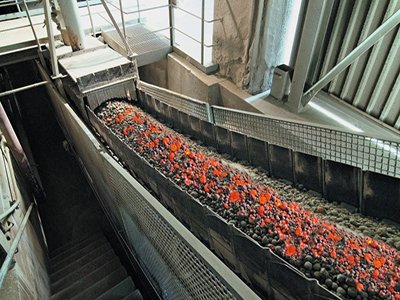
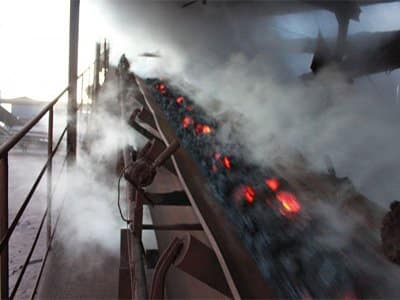
Heat resistant belts are required in many applications such as in cement plants, steel mills and metal refining plants. Care needs to be taken in selecting the appropriate cover grade to ensure that the rubber and the belt carcass will retain its integrity even after a long service life. The correct compound must be selected to ensure there is no cracking of the rubber surface or delamination between the plies.
There are two main rubber polymers used in this application: SBR and EPDM. Whilst EPDM rubber has generally better physical properties of heat resistance, SBR rubber still has good overall physical properties, but at more competitive prices. Defining the operating conditions and selecting the rubber correctly will ensure the most economical solution. The surface temperature of heat resistant conveyor belt varies with the material type, belt speed, loading rate and particle size and shape (i.e., contact area with the belt). In order to select the proper heat resistant conveyor belt, it is necessary to consider not only the material temperature to be conveyed but also the surface temperature of conveyor belt.
Excellent heat resistant and abrasion resistant cover rubber compound. Recommended to protect conveyor belt from surface cracking and hardening by heat. Specially treated and dipped fabric to minimize carcass shrinkage by heat ageing.